Spotlight on a New Type of Partner
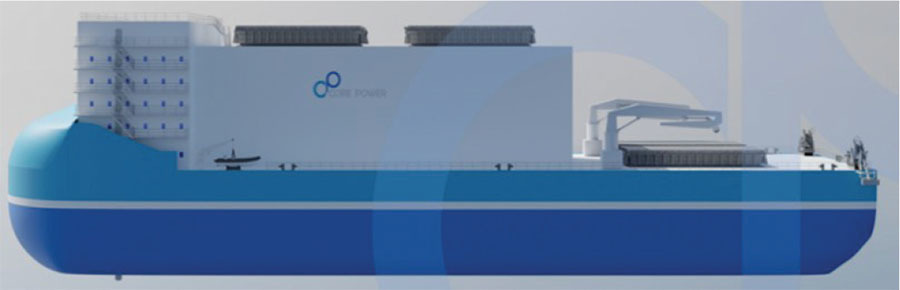
Once in a while, a partnership possibility will come along that intrigues an entire industry. New industries and technologies like 3D printing or AI pop up outside of the traditional maritime landscape, find a champion within the seaport purview, and then find ever-broadening applications within seaports.
CORE POWER is on the leading edge of the floating power market. It is facilitating the development of safe nuclear technology to support the maritime industry and seaports.
Nuclear-propelled naval vessels have been around for decades, as have small nuclear reactor power plants on land, but there are no commercial vessels with nuclear propulsion and no seaports with floating nuclear power plants (FNPPs). CORE POWER said that can change.
CORE POWER is helping the OECD advance nuclear technologies for maritime applications. Ocean carriers need help to reduce emissions to zero by 2050. State Relations & Strategic Alliances VP for CORE POWER, Bob Bryans, said, “We are committed to demonstrating the environmental superiority of advanced nuclear technologies and pledge to meet or exceed the highest international standards in safety and security, safeguards and health protocols, environmental protection, and ethical and responsible business practices.
Nuclear-propelled ships could be a boon to U.S. shipbuilding. It’s been over a century since the Jones Act was first enacted to try to help keep shipbuilding in America. Bryans said bringing Generation IV advanced nuclear reactor technology to the maritime sector could be a step toward invigorating US-based shipbuilding and crewing.
Floating nuclear power plants may prove to be a solution to fluctuating power needs, emergency response at seaports and surrounding communities, or long term grid load.
To drive maritime nuclear forward, CORE POWER is developing strong partnerships. They are already partnering with TerraPower and Southern Company on the development of a Gen IV advanced small modular reactor, a safe molten chloride fast reactor technology for use on commercial container ships. They have partnered with Westinghouse Electric Company to use the eVinci heat pipe reactor for use in a floating nuclear power plant. CORE POWER is working closely with the White House National Security Council’s Shipbuilding Office, the Department of Energy Nuclear Energy office, the Department of Defense and Department of the Navy, Defense Innovation Unit, and Naval Postgraduate School, as well as Congressional members and committees, and government and independent agencies responsible for maritime and nuclear regulatory oversight and standards.
Bryans said CORE POWER is now talking to seaports to develop public-private partnerships (P3s) that promulgate applications. Some of the leading benefits of P3s, he said, are that the external partner can: lend “capital intensity” to seaports, who routinely struggle with exorbitant capital needs; provide operational expertise to improve efficiency and service quality; help share risks, creating more sustainable development models; enhance “innovation capacity,” by introducing new technologies and operational approaches; generate revenues; and accelerate speed to market.
Some of the benefits to ports of floating nuclear power plants, Bryans said, include: reliable power supply (this may be particularly interesting to ports with high simultaneous electrical load on certain days, or to ports with unstable power or local grid constraints); space efficiency (using water space rather than valuable shoreline, preserving land for core port operations); mobility and flexibility (FNPPs can be repositioned based on changing needs and can support port expansion without major land-based infrastructure changes); emissions reduction (nuclear power carbon emissions are usually considered nominal); shore power capability for cruise and cargo vessels; and desalination potential, allowing fresh water for port operations and surrounding communities.
It may not happen tomorrow, but it is clear that Generation IV nuclear reactors are emerging on the maritime scene. The uptake may be quick. Right now, they are a new partnership opportunity for some ports, particularly those with potential power insecurity.