Anchoring the Nuclear Renaissance
How small modular reactors and floating nuclear plants will power U.S. ports and beyond
By Nick Fortuna
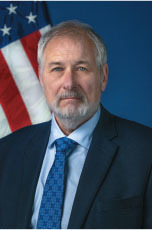
The United States is racing against China to develop nuclear-powered ports that can serve nuclear-powered ships, and port authorities will play a critical role in determining which country secures that important strategic advantage first, according to Stephen M. Carmel, administrator of the U.S. Dept. of Transportation’s Maritime Administration.
Carmel will discuss the federal government’s commitment to supporting nuclear power at U.S. ports at a keynote panel Sept. 29 during the AAPA’s annual convention at the New Orleans Marriott. He pointed to four recent developments as evidence that the nuclear transition has begun in earnest:
- The Maritime Administration (MARAD) issued a request for information to develop small modular reactors (SMRs) for commercial shipping, aimed at cutting fuel costs, extending vessel range, and revitalizing U.S. shipbuilding. The RFI was issued May 7 and had an Aug. 5 deadline.
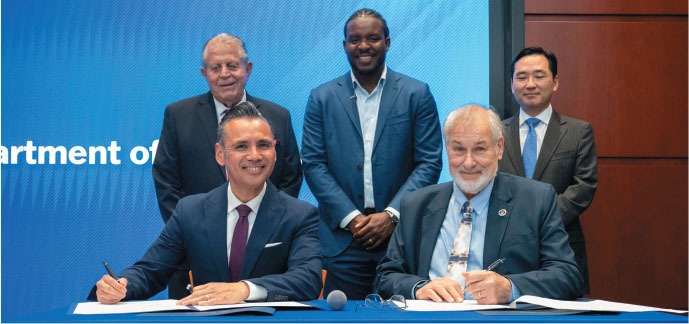
- In July, MARAD signed a first-of-its-kind memorandum of cooperation with the Port of Long Beach in Southern California to advance the development of SMRs to power commercial vessels, ports, and other maritime assets.
- On Aug. 26-27, Washington hosted the launch of the IAEA’s ATLAS initiative, short for Atomic Technologies Licensed for Applications at Sea. The program “begins building the international framework for civil nuclear power at sea, and hosting its launch puts the United States where it belongs on this transition: setting the standards rather than adopting someone else’s,” Carmel said.
- The U.S. government has stood up an “interagency regulatory architecture” devoted to advancing the nuclear transition, Carmel said. Agencies such as the American Bureau of Shipping, the Coast Guard, the Nuclear Regulatory Commission, and the Department of Energy will collaborate with ports such as Long Beach to develop safety standards, operational guidelines, and inspection protocols for SMRs.
“This is real, and ports are the center of gravity in this transition,” Carmel said. “The nation that fields nuclear-powered ports serving nuclear-powered ships holds a form of commercial and strategic advantage its competitors cannot rent, and China is pursuing the same prize deliberately. That is why this is a strategic priority: It is an instrument of national power.”

“Whoever deploys the technology first and at scale will set the standards everyone else must live with for generations,” he added. “This is a race with no second place; you either win or lose. Whoever controls standards controls trade, so the stakes are high.”
Ports that partner with MARAD on this initiative will contribute expertise and key data such as terminal power demand. They also will participate in emergency planning, workforce development, engagement with surrounding communities, and validating proposed standards against real-world port operations, Carmel said.
In early August, MARAD was in discussions with other ports, carriers, labor, and industry groups about agreements similar to the one with Long Beach, according to Carmel. He said the AAPA’s keynote panel is a call to action for port authorities.
“Any gateway that wants to be nuclear-ready should be talking to us now,” Carmel said. “Readiness is competitive positioning. The ports that do the acceptance work early will be where the first demonstrations, the first vessels, and the associated investment land. Don’t wait for a reactor to show up at your breakwater to start the conversation.“
A First Step in Long Beach
Through its agreement with MARAD, Long Beach eventually could become the first port in the world powered by nuclear energy. The port’s 22 ship terminals have an average electricity bill of about $420,000 a month and have seen energy demand grow as the port has pushed to electrify cargo-handling equipment and other operations that typically rely on fossil fuels.
Long Beach is seeking to double its annual container throughput to 20 million TEUs by 2050, and nuclear energy will help “power the port of the future,” according to Dr. Noel Hacegaba, the port’s chief executive.
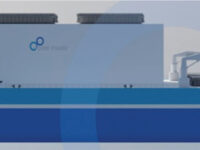
“This first-of-its-kind agreement with MARAD marks a defining moment for American ports and the U.S. maritime sector and allows us to leverage strong federal leadership and private-sector innovation to catalyze SMR technology to safely and securely support the next generation of shipping,” Hacegaba said. “With demand for energy rising, grid capacity tightening, and zero-emissions deadlines approaching, energy diversification has never been more critical, and SMR power will play a key role.” Long Beach has entered into a lease agreement with Bluecore Energy that allows that energy startup to assemble, test, and store SMRs on a barge at the port. The company, founded last year by CEO Kofi Asante, raised $10 million in funding from investors this summer. It aims to develop SMRs that operate aboard barges as floating nuclear power plants (FNPPs), delivering reliable, zero-emission power directly to ports, critical infrastructure, and cargo-ship propulsion.
In July, Bluecore established its headquarters at the Port of Long Beach, where it delivered its first barge and electric test reactor. The SMR heats water, producing steam that is transferred to a generator, which then spins a turbine to produce electricity. The water-cooled system has a closed loop, so it doesn’t need a continuous supply of fresh water.
Bluecore’s first SMR is designed to produce 10 megawatts of electricity, enough to power about 15,000 homes, Asante said. It can fit within a standard shipping container and requires refueling once every few years. The small size of the reactors means that multiple SMRs could be placed on the same barge, allowing ports to scale up electricity production easily.
Asante said the SMR was built with several layers of ̶safety and redundancy,” like having the uranium protected by a thick-steel pressure vessel and then padded with concrete shielding and steel lining. There also are multiple shutdown systems and passive safety features, he said.
The SMRs will be able to connect to the power grid through subsea cables, and the barges can be moved by ship to different locations, giving ports additional flexibility. Asante said Bluecore hopes to be providing ports with electricity within the next few years.
“A number of ports have reached out to us with the same message: We have growing energy needs, we want to be a zero-emission port, and we don’t have a lot of real estate available to us,” Asante said. “Our solution addresses those pain points. We want to be at all the major ports.”
Potential Game-Changer
Jeff Pollack, chief strategy and innovation officer at the Port of Corpus Christi, said SMRs could enable ports to achieve two competing objectives: meeting their surging energy requirements while reducing emissions. SMRs could complement renewable-energy installations such as wind and solar and could allow ports to scale up the production of electrolytic hydrogen.
Additionally, SMRs could help meet the need for firm, dispatchable electricity amid the rapid rise of data centers, Pollack said.
“For ports, commercialization of nuclear power may unlock a future in which the availability of electricity is no longer a barrier to operational optimization,” he said. “Ports are home to a wide range of high-energy-using industries and often are at the end of the road in terms of transmission grids, so the availability of electricity can be a constraining factor.” Looking ahead about a decade, SMRs could provide power to a civil fleet of nuclear-powered oceangoing vessels. This past June, the American Bureau of Shipping approved a design for a nuclear-powered ship developed by a group that includes the Massachusetts Institute of Technology’s Center for Ocean Engineering, the Greek-owned shipping company Capital Group and South Korea’s Hyundai Heavy Industries.
Cargo ships currently account for about 3% of total carbon-dioxide emissions, according to the UN’s International Maritime Organization, which has imposed rules that will require owners of oceangoing vessels to pay governments for their emissions beginning in 2028.
Pollack said nuclear-powered vessels could eliminate the continuous “optimization exercise” in which vessels seek to travel “as fast as is useful,” without burning fuel and generating emissions unnecessarily. It makes no sense for vessels to travel as fast as possible and increase fuel consumption if they face long anchorage times at ports.
Therefore, nuclear power could allow vessels to travel at higher speeds without the tradeoff associated with conventional fuels and could unlock new efficiencies in ports, Pollack said. In addition, since nuclear-powered vessels rarely have to be refueled, they have the potential to eliminate bunkering at ports, which could speed up turnaround times and simplify operations for ports, Pollack said.
In August, the Port of Corpus Christi was among the ports working on an agreement with MARAD similar to the one with Long Beach, according to Pollack. Corpus Christi also is working with the London-based energy company Core Power on a study to evaluate the regulatory, technical and logistical feasibility of deploying FNPPs and accommodating nuclear-powered ships at the port, he said. In June, Core Power partnered with Maersk and the Port of Rotterdam in the Netherlands to publish a white paper examining the safety and regulatory considerations associated with nuclear-powered ships calling on major EU ports. Core Power said the work was meant to support a wider community of ports, regulators, ship owners, and technology developers in understanding the steps required to move nuclear-ship port calls from “conceptual acceptance to operational readiness.”
Rotterdam is the top receiver of cargo from Corpus Christi, which is the leading exporter of U.S. energy products such as crude oil and liquefied natural gas. In time, Corpus Christi’s feasibility study could provide the first “end-to-end look at a potential nuclear-ready trade corridor,” Pollack said.
Mikal Bøe, CEO of Core Power, said a “key to the success of civil maritime nuclear propulsion is the trusted confidence” of port cities and their stakeholders in calls by nuclear-powered merchant ships. The Rotterdam study highlights where further work is needed, “including modernized port guidance, interagency regulatory alignment, nuclear-specific safety and security requirements, and best-in-class emergency preparedness to build public trust,” he said.
“Public trust and confidence is fundamental if we’re going to transform the future civil shipping sector,” Bøe said. “Greenhouse-gas emissions from the existing shipping fleet have become unsustainable and have led to the slowest sailing times we’ve seen in decades. Now is the time to start the important work of evaluating nuclear shipping in a modern context.”
More Than Just a Green Issue
Carmel, administrator of MARAD, said environmental concerns are only one factor driving the development of nuclear-powered ports than can serve nuclear-powered ships. Leading this technological revolution also could revitalize the U.S. shipbuilding industry, which is a pillar of America’s Maritime Action Plan, published by the White House in February.
Carmel noted that the United States currently accounts for less than 1 percent of global commercial shipbuilding and hasn’t built a ship for the export market since 1960.
Nuclear energy also will make ports and supply chains more resilient, another priority of America’s Maritime Action Plan. SMRs can generate electricity regardless of whether the sun is shining or the wind is blowing, and they give ports a reliable source of power if the grid is down due to a natural disaster or cyberattack, Carmel said.
“The mission is the intersection of energy dominance and maritime dominance,” he said. “Small modular reactors and floating nuclear power plants offer firm, dense, around-the-clock power on a footprint a working port can actually spare, with the added ability to keep a strategic port operating through a grid disruption. [Nuclear energy] keeps delivering during exactly the contingencies in which grid-tied generation is least dependable.”

SEPTEMBER 28-30, 2026
Learn more about this topic at the AAPA Annual Convention!
Keynote — Anchoring the Nuclear Renaissance: How SMRs and FNPPs Will Energize U.S. Ports and Beyond
Monday, Sept. 28
1:30 p.m. to 2:15 p.m.
See the Convention feature on pages 24-29 for more information.