The Next Wave of Automation in Ports Could Be Rail-based
By Tom Gresham

Automation in the port environment has been advancing rapidly as equipment and technology becomes increasingly sophisticated. However, the rail component of ports still has considerable room for advancement in the automation field.
Adam Franco is director of product management and business development for Wabtec, a global provider of equipment, systems, digital solutions, and value-added services for the freight and transit rail sectors. Franco will be speaking about his company’s efforts with rail automation projects at the AAPA Annual Convention in New Orleans. Franco is part of Wabtec’s Advanced Technology Group, which is exploring a range of technology innovations.
Franco spoke with Seaports about ongoing Advanced Technology Group projects that offer the most potential benefits for the ports industry, including two solutions related to creating more efficient rail movements in constrained port environments and one focused on the inspection process.
Pathfinder and Maverick
Wabtec Pathfinder is a plug-and-play digital hardware and sensor package designed to automate legacy locomotives. It decouples a railroad’s technology upgrades from the mechanical lifespans of older assets, letting operators implement modern suites like Positive Train Control (PTC) and Trip Optimizer without replacing entire legacy units. Pathfinder essentially would use existing locomotives and equip them with new digital equipment and sensors for autonomous operation.
Franco compares Pathfinder to a Roku stick for your TV. If you want Netflix on your TV, but you have an old TV, then you could buy a Roku stick to plug into the back of your TV and get Netflix — rather than buying a new TV.Open advertisement in lightbox
The Pathfinder is like buying a Roku stick for making a locomotive autonomous, he said.
“It doesn’t matter what your fleet is,” Franco said. “A lot of times in the ports, they have a mixed bag of old-style locomotives, and those old locomotives are really hard to put new technology on.”
Old locomotives with people onboard can slow down largely automated ports, often for safety reasons, Franco said.
“Pathfinder gives an economical way to modernize the digital footprint of a locomotive without having to do a significant repurchase,” Franco said. “A lot of times, that’s what ports are looking for. Sometimes, they’re even leasing locomotives. So you’re not going to make an investment in those kinds of assets when you’re buying older assets or you don’t even own the asset, but Pathfinder gives you a way to make that investment without having to be tied to the locomotive itself.”
Franco said early discussions with ports potentially interested in Pathfinder include a port in Australia that is fully automated, aside from the locomotive and the train crew that supports loading and spotting the cars. Every time the locomotive comes in and out of the port, all unloading operations from the container ships cease because the port does not want to have people beneath cranes in operation.
“So one of the use cases for that is using Pathfinder to essentially bring the trains in and out so they never have to stop operations,” Franco said.
Franco said the port believes Pathfinder could free up container movements and have a major impact on the number of TEUs that it can get through the port, creating notable gains in efficiency.
Meanwhile, Wabtec’s Maverick is a small autonomous locomotive that would haul short trains traveling distances less than 750 miles, such as between a port and a distribution center. Designed to haul 10 to 15 railcars, a Maverick would be equipped with perception and teleoperation technologies, enabling it to be operated from a remote dispatch center. Its purpose is to capture a short-haul, just-in-time market that tends to be underserved by the rail industry and where transloading from truck to rail is cost-prohibitive, according to Railway Age.
Franco said the main lines have gotten “very efficient” so that a 15,000-foot train with two people on board can travel from Chicago to Los Angeles. However, the bottlenecks are connected to the ports. Maverick is meant to help address that in the same way investments have paid off with modernized, automated crane movements.
A potential use case for Maverick is specific to ports near major population areas, Franco said. He notes long trains leaving those ports can block multiple crossings and create major traffic challenges for the surrounding area, particularly if something goes wrong with the train. Maverick offers the potential for a more consistent and less disruptive approach to getting containers out on trains, Franco said.
Franco believes that Maverick is a few years out from the marketplace as it navigates rounds of testing and the regulatory process. He expects Pathfinder to launch later this year.
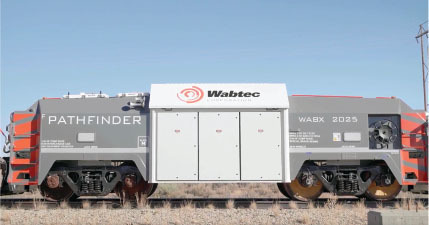
RailGhost
RailGhost is a platform for robotic and inspection capabilities in railyards. RailGhost uses automated movement throughout rail yards, traveling on top of rails, going underneath railcars, and navigating through switches and grade crossings.
Franco said a major challenge in railyards is the need to inspect the track when it is covered with rail cars. Another challenge is the need to inspect individual rail cars before they leave, but that requires a lot of time and a person walking the length of what could be a very long train.
The RailGhost sled travels along the track making those necessary inspections. For instance, Franco says one of the tests that must be done before a train leaves a railyard is ensuring brake pipe pressure is adequate. If it isn’t, then an operator has to start walking the length of the train — sometimes at night or in inclement weather or both — and find and fix the air leak that is keeping the pressure from holding.
Instead of the operator making the walk, RailGhost would travel down the track, traveling faster than a walking person, and detect the leak and report back to the operator, who can then fix it.
Franco said RailGhost would help not only improve efficiency in the inspection process but also strengthen safety for the personnel in the railyard. In addition, it allows workers to devote more of their time to repairs rather than the often time-consuming inspection process.
“There’s no shortage of car repair that has to happen, and a lot of times, cars get stuck in yards for two, three, four days waiting on a repair before they can continue on,” Franco said. “So now this becomes a shift where you’re turning highly skilled fixers, and you’re just having them fix, and you’re using less of them to be finders. I think what we’ll end up seeing is a net improvement overall across the entirety of the network in the state of the rail cars that are going in at these ports and these big intermodal three and five packs that have to get inspected and maintained.”
Franco believes RailGhost could be particularly beneficial in smaller ports where rail inspections often are done beneath cranes, meaning operations have to stop during the process. Many larger ports have staging areas away from cranes where trains can be staged and inspected.
“Now you’ll be able to do that inspection while you’re loading it,” Franco said. “The RailGhost can be underneath, doing the entirety of the inspection, doing your whole mechanical inspection, as you’re loading the containers. If you find out that a car is bad, we can auto-notify and say, ‘This car is bad. Don’t put any containers on this.’”
Franco said RailGhost’s potential benefits are not only in efficiency but in predictability. In fact, he said potential customers have emphasized the appeal of having a more predictable and reliable loading and unloading departure strategy where “they know how long it’s going to take.”
“If they can get a predictable answer when that cargo is going to flow out, that really matters,” Franco said. “When am I scheduling the next ship to come in? When is this going to be off my berth? When am I calling the next loco crew? When am I calling the trucks?”
Franco said Wabtec hopes to deliver RailGhost sleds to its first customer next year.

SEPTEMBER 28-30, 2026
Learn more about this topic at the AAPA Annual Convention!
Keynote Panel — Driving Impact with Autonomous Rail Vehicle & Robotic Inspection Platforms
Tuesday, Sept. 29
1:15 p.m. to 2:00 p.m.
See the Convention feature on pages 24-29 for more information.