U.S. Ports at an Inflection Point: Performance, Resilience, and the LNG Surge
North American ports, despite their scale and capital base, are among the most vulnerable during periods of stress.
By Gordon Feller
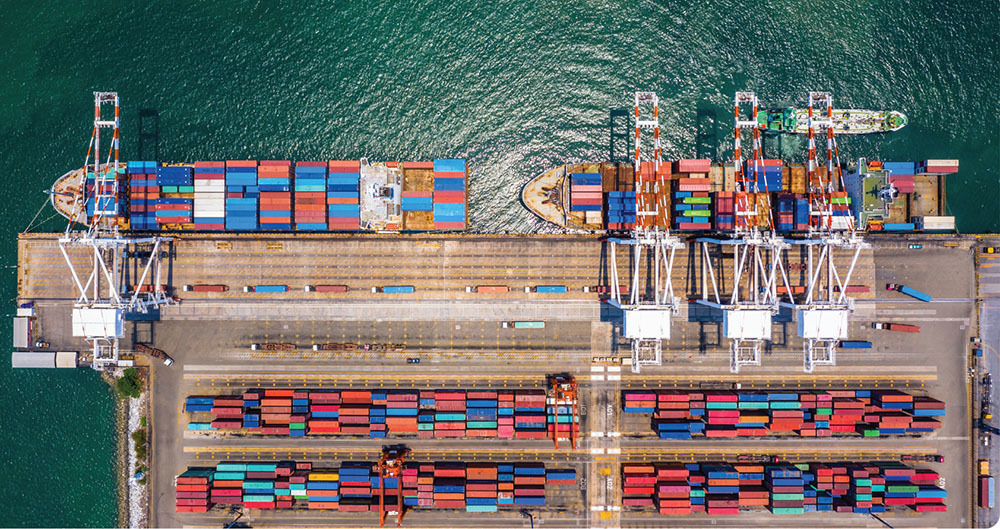
In the early morning hours along America’s coasts and river ports, the choreography of cranes, tugs, rail, and trucks resumes with relentless precision. Yet beneath this familiar rhythm, U.S. ports are undergoing one of the most consequential transitions in their modern history. The lessons of the 2020–2024 disruption cycle, captured so vividly in global port performance data, have converged with new geopolitical, climate, and energy realities. As the industry moves through 2025 and toward 2026, U.S. ports are no longer simply recovering. They are being re-engineered.
The Container Port Performance Index (CPPI) narrative of the past five years highlighted a sobering truth: North American ports, despite their scale and capital base, were among the most vulnerable during periods of stress. That vulnerability has become the catalyst for reform. The result is a port system increasingly shaped by three overlapping forces: structural modernization, supply-chain diversification, and the rapid rise of LNG-related maritime activity.
Between 2020 and 2022, U.S. ports became global symbols of congestion. Los Angeles–Long Beach, handling roughly 40 percent of U.S. containerized imports, routinely saw dozens of vessels anchored offshore. Average vessel time in port stretched far beyond global norms, reflecting not just pandemic shocks but long-standing structural weaknesses.
The CPPI made these weaknesses impossible to ignore. Compared with East Asian peers, U.S. ports struggled with fragmented governance, limited automation, constrained terminal footprints, and underdeveloped hinterland connections. A ship could be discharged efficiently at berth, only to have its containers immobilized by rail bottlenecks in Chicago or chassis shortages in Southern California.
By 2023, conditions improved. By 2024, performance stabilized, even amid Red Sea diversions and Panama Canal drought constraints. But the deeper lesson for U.S. port authorities and policymakers was not about returning to “normal.” It was about redesigning ports to withstand a permanently more volatile operating environment.
As congestion eased, cargo did not simply revert to old patterns. Instead, the U.S. port system began to rebalance.
East Coast ports such as Savannah, Charleston, and Virginia accelerated their ascent. Savannah’s Garden City Terminal continued its aggressive berth expansion and on-dock rail investments, positioning itself as a preferred gateway for discretionary cargo bound for the Midwest. Charleston advanced its deepening projects and inland port strategy, explicitly marketing reliability over sheer scale.
On the Gulf Coast, the Port of Houston emerged from the pandemic years with a sharpened strategic focus. The Houston Ship Channel Expansion (Project 11) advanced steadily through 2024–2025, enabling larger vessels and improving two-way traffic. But containers were only part of the story. Energy cargoes, particularly LNG, were reshaping Houston’s long-term trajectory.
Meanwhile, West Coast ports pursued a more complex recalibration. Los Angeles and Long Beach invested heavily in data platforms, appointment systems, and near-dock rail capacity. Oakland leaned into niche strengths, including agricultural exports and green shipping corridors. The West Coast did not disappear from global trade flows; it became more selective, more digitized, and more tightly integrated with inland logistics.
By 2025, LNG was no longer a specialized commodity moving quietly through a handful of terminals. It had become a defining feature of U.S. maritime energy trade.
Several forces converged to drive this shift. European energy security concerns, reinforced by geopolitical instability, continued to anchor long-term U.S. LNG export contracts. Asian demand, particularly from Japan and South Korea, rebounded strongly as utilities sought flexible supply portfolios. Domestically, LNG also gained traction as a marine fuel, driven by tightening emissions regulations and fleet renewal cycles.
Ports along the Gulf Coast became the epicenter of this transformation. Sabine Pass, Corpus Christi, Cameron, and Freeport expanded liquefaction capacity or advanced new financing rounds. These investments rippled outward. Channel deepening, berth reinforcement, specialized cryogenic handling equipment, and enhanced safety zones became port-wide priorities.
The financing surge behind LNG was as consequential as the cargo volumes themselves. Infrastructure funds, sovereign wealth investors, and pension capital flowed into port-adjacent LNG projects, viewing them as long-lived, revenue-stable assets. For ports, LNG terminals offered not just throughput but predictable fee income, anchoring broader capital programs in uncertain macroeconomic conditions.
Unlike container cargo, LNG imposes a distinct operational logic. Vessel calls are fewer but longer. Safety protocols shape berth allocation. Channel access must be meticulously managed. As LNG traffic expanded, ports were forced to rethink scheduling, pilotage, and coexistence with container and bulk operations.
The Port of Corpus Christi provides a clear example. By 2025, it had evolved into one of the largest U.S. energy export gateways, handling crude oil, refined products, and LNG.
Coordinating LNG carrier movements with other vessel classes required advanced vessel traffic systems and close collaboration with the U.S. Coast Guard. The payoff was scale. Corpus Christi moved from a regional port to a globally strategic energy node.
This LNG-driven operational sophistication began to influence other U.S. ports. Even ports without liquefaction terminals invested in LNG bunkering capabilities, anticipating demand from container lines adopting dual-fuel vessels. Jacksonville, Tacoma, and Port Fourchon each pursued LNG-related projects, positioning themselves within a rapidly evolving maritime fuel ecosystem.
One of the most underappreciated outcomes of the LNG boom has been its influence on port resilience thinking. Energy cargoes demand redundancy, scenario planning, and high-reliability systems. These disciplines are now bleeding into container operations.
Ports that host LNG terminals tend to invest earlier in digital twins, emergency response coordination, and cyber-physical security. By 2026, these capabilities increasingly support all cargo types. In this sense, LNG is not just reshaping port balance sheets. It is professionalizing risk management across the waterfront.