Tariffs: An Update, One Year Later
How did ports fare in 2025 with the on-again/off-again tariff directives
By Tom Ewing
Background
A year ago, US tariff policies were a high-profile concern at AAPA’s 2025 Legislative Summit which included a Mainstage Panel discussion focusing on possible impacts from upcoming tariffs.
Two port executives were on the panel: Dr. Noel Hacegaba, CEO, Port of Long Beach, CA, and David Gutheil, then Interim President & CEO/Chief Commercial Officer, Port of Cleveland, OH, (Gutheil is now the Port’s Chief Operating Officer). The panel also included Jon Gold, National Retail Federation.
Looking ahead, the panelists were concerned that —
- Tariffs would force shippers to make new and different transport decisions, distorting markets, rerouting vessels and inhibiting trade as people tried to figure out a brave new world.
- That these changes would leave port facilities underused or even idle.
- That various new social policies linked to tariff revenue — from drug interdiction to shipbuilding to workforce development — were too unorganized, as presented, to convey confidence in beneficial outcomes.
Now, a Look Back
In February, Hacegaba and Gutheil were asked to update: How did their ports fare in 2025 considering the roller-coaster, onagain/off-again directives and decisions that came to characterize the administration’s tariff policies?
Additionally, this inquiry expanded to executives at other US ports. To be clear, this outreach was informal and by no means included every US coastal port. Some ports officials did not respond to inquiries. Others said they were ready and willing to discuss any aspect of their operations, except for tariffs.
Insights: Port of Long Beach
POLB CEO Dr. Noel Hacegaba described some of the scattered and diverse fallout from tariffs. He noted up front that tariffs are taxes and, indeed, affect trade. But despite new uncertainties, tariffs did not decrease trade at Long Beach. “One of the things we saw was cargo diversification,” Hacegaba explained. “Six years ago,” he continued, “about 70% of POLB’s cargo was linked to China; today, it’s about 60%.” Trade from Southeast Asia is increasing, particularly from Vietnam, POLB’s second-largest trading partner. These changes weren’t just from tariffs, Hacegaba said, and they reflect other geopolitical and commercial influences. “The reality, however,” Hacegaba commented, “is that uncertainty is here to stay.”
Hacegaba was asked about worst-case scenarios. He noted how tariffs cause conflicting outcomes. On the one hand, as shippers anticipated tariffs, they moved cargo earlier, sending a surge to US ports. That frontloading, Hacegaba said, “catapulted POLB to our busiest year on record — 9.9 million TEUs. Clearly, the worst-case scenario did not materialize, and we were able to handle record cargo volumes.”
On the other hand, exports were down, nearly 6% year-over-year due to retaliatory tariffs from trading partners. Some declines were dramatic. POLB soybean exports to China, for example, fell 95%. Because of the surge early in 2025 POLB was the nation’s busiest port through April. Then, container volume ebbed and flowed due to the on-again/off-again nature of tariffs and reciprocal tariffs, creating uncertainty, Hacegaba said, “for consumers, businesses and supply chain partners.”
Finally, Hacegaba was asked what he would advise the President now about tariffs? He reiterated that tariffs are a tax and added: “Trade policies have far-reaching impacts on U.S. supply chains, global competitiveness, and the movement of goods through America’s ports. We urge policymakers to prioritize predictable, transparent, and cooperative frameworks that reinforce the United States’ position as a leader in global commerce.”
Insights: Port of Cleveland
Cleveland is largely a breakbulk port, not a container port like POLB. Steel imports — about 40,000 to 50,000 tons/year from Canada — are a major activity at Cleveland and other Great Lakes ports.
Dave Gutheil was asked for his insights now, after one year of new tariffs. He said the biggest effect early last year was “the uncertainty caused throughout global supply chains. Many cargo owners couldn’t properly predict costs due to the ever-changing tariff environment, and this led to reduced cargo volumes at many ports around the US, including Cleveland.”
Less volume resulted in reduced hours for longshore workers, and idle time for equipment. Whether those reductions will persist, and to what degree, remains to be seen, changes that will come into clearer focus when Great Lakes shipping starts again in the spring.
Gutheil commented further that “ports historically plan for worst- and best-case scenarios. The decrease in volumes caused us to analyze our current cargo mix and look for other cargoes that we could introduce into our business model.” Indeed, Port officials have identified different cargoes that align with Cleveland’s capabilities. “These discussions,” Gutheil said, “with potential clients are ongoing.”
A Customs Broker’s View from New Orleans
The International Freight Forwarders & Customs Brokers Association of New Orleans (IFFCBANO) is a professional association of licensed international freight forwarders. Member companies provide expertise regarding international transportation services. The Association was a sponsor at New Orleans 2025 State of the Port event.
Kevin Wild is an IFFCBANO Board Member and he is Executive Vice President, Business Development for Page & Jones, a New Orleans company that facilitates export-import transactions. Wild was asked for his insights about how tariffs have impacted business operations. (His comments are not on behalf of the Port of New Orleans, which declined to respond to these tariff inquiries.)
Wild said that tariffs have skewed trade and operations at US seaports. He said container volumes are down at ports across the US. He added, though, that the decline is not solely because of tariffs. Other issues were at play, e.g., the threat of an east coast/Gulf Coast ILA strike shifted significant volumes to west coast ports. In addition, new ocean carrier partnerships, port rotations and capacity deployments also instigated changes.
Wild said that frontloading has impacted ports because some companies cannot pay higher tariffs and they are trying to delay shipments hoping for tariff reductions. “The on-again/off-again nature (of tariffs),” Wild said, “causes even more caution. Those companies that can wait it out on the sidelines are doing just that.”
Insights: Port of Los Angeles
Gene Seroka is POLA’s Executive Director. In an interview Seroka said that a look-back assessment at tariffs can be conditional, dependent on vantage point. Seroka said that for POLA “it was a real roller coaster of a year. When hard policy came out, importers slammed on the brakes, not knowing if a new trade and tariff announcement would come out in two hours, two days or two months.”
Then, as policies softened, importers took advantage to speed cargo through the supply chain. In May, POLA’s business dropped by 30% because of 145% tariffs on China, a rate Seroka described as “insurmountable.” Then, rates changed and in July POLA handled over a million container units, just the second time ever for that volume. “By the end of 2025,” Seroka added, “we came in with our third best year ever, but there were a lot of peaks and just about the same number of valleys.”
The Administration has imposed tariffs based on two federal laws: The International Emergency Economic Powers Act and Section 232 of the Trade Expansion Act of 1962. Seroka said both have impacted trade. POLA’s largest trading bloc is the $33-trillion Asia-Pacific region. After tariffs, Seroka said “we saw fits and starts in trade patterns. Cargo moved from China to Southeast Asia. We needed new relationships with trading partners.” He commented that freight handlers “spent an inordinate amount of time doing simulations and ‘what if’ scenarios to see how the tariff changes would impact their companies.”
Seroka said agriculture was particularly hit hard, at least at POLA. Agriculture is the Port’s largest export sector. He commented that “the American farmer has been caught in the crosshairs of all this trade negotiation.” For example, despite speculations that soybean exports to China would recover, he noted “that hasn’t been the case at POLA.” Rather, Argentina and Brazil established contracts with China, and, in another example, customers stopped buying US almonds, shifting to suppliers in Australia.
Seroka was asked about the imminent Supreme Court ruling on tariffs, expected in February. He commented that, yes, it is important, but he pointed out that the president is committed to tariffs and that even if the court ruled the tariffs unlawful the president has said he will seek new, more defensible tariff policies.
What would he advise the president now? “It’s our belief here in Los Angeles,” Seroka replied, “that a rules-based trade system is an American imperative to protect jobs, companies and iconic brands.” Seroka pointed out that every four containers handled at POLA equates to one American job. He supports efforts to coordinate and align industrial growth across sectors, from shipbuilding to manufacturing, but he noted that this requires a decades-long commitment with focused and coordinated planning.
In closing, Seroka commented that, regarding trade policies, “I don’t see us dropping off a cliff with respect to cargo volume (despite) a relatively choppy environment.” For 2026 he predicts single digit declines in Los Angeles and remains focused on the bigger goal: “getting our arms around how we can boost American exports, including the support needed for the American farmer.”
Insights: Port of Hueneme
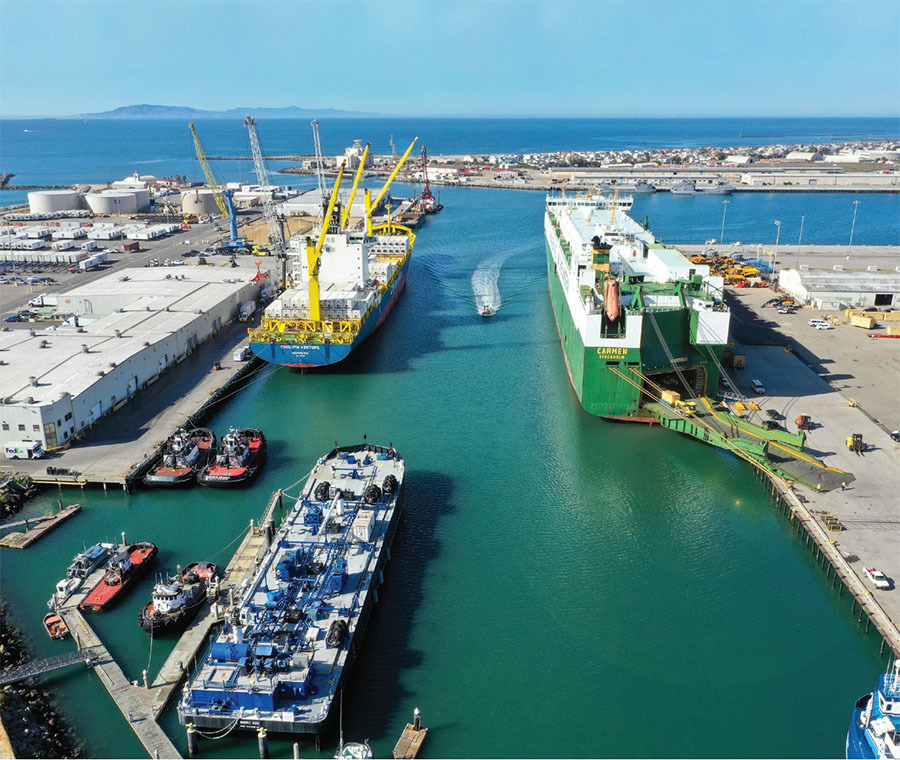
Automobiles and refrigerated food containers are the two main cargoes at the PofH, explained Stacy Lange, the Port’s Chief Commercial & Public Affairs Officer (CCO). Overall, in 2025, auto shipments declined due to tariffs, but the perishable market improved over 2024, despite slight price increases.
Automobiles arriving at the port from worldwide suppliers were impacted by fluctuating tariffs, making it difficult for the auto market to plan and forecast. Fortunately, this smoothed out a bit after tariffs were reduced or paused, the result of ongoing trade negotiations.
Vehicle carriers at Hueneme were further impacted by Section 301 fees set to counter China’s shipbuilding dominance and then again when that fee expanded to all foreign built ships. “The resulting fees of $46/net ton equated to approximately $1 million per U.S. voyage,” Lange said, adding that “We estimated the potential impact to our customers at $50 million per year.”
She said the port, working with AAPA and the California Association of Port Authorities (CAPA), requested a review of the 301 fees. Subsequently, in November 2025, the USTR 301 fees were paused for one year, part of the broader deal by the administration that all tariffs and fees on China would be paused and then reevaluated in November 2026.
This turbulence hit Hueneme hard. Lange said car volumes dropped 23% from July 1 to December. “We expect some recalibration,” she commented, “but we don’t expect to fully recover that lost market share. Now we are working on expanded export capabilities and other diversification strategies that help address any losses associated with shifting trade policy.”
Lange’s advice for the president? That he recognize the importance of continuity, predictability and stability. “Our customers share that they struggle with so much fluctuation in trade policy and international deal making, which ultimately challenges their ability to plan for and make investments in American ports and manufacturing. At the Port of Hueneme, we advocate for thoughtful implementation of trade initiatives.”