Ports in the Climate Crisis
Ports remain on the front line of climate change, and that position is only going to become more critical in the years ahead.
By Tom Gresham
Ports remain on the front line of climate change, and that position is only going to become more critical in the years ahead. No matter where they are located, ports are proactively preparing for climate-related challenges of all kinds through committed planning and execution that touches on everything from infrastructure and technology to budget and community engagement. More than ever, ports must look with a critical eye at how well they are prepared for what awaits them in the future, including heightened dangers they have never faced before.
Climate change’s potential risks for ports include flooding events caused by subsidence and sea level rise, powerful winds, extreme heat and extreme cold — all weather-related conditions that could bring potential major impacts to port operations.
“These events not only cause restrictions to our roadways and shipping safety but also can impact power outages,” said Emily Federer, director of sustainable development for the Port of New Orleans. “All international ports, by the nature of being a port, will be affected by these conditions — however, most if not all, of our American ports have been looking at these data points to account for emergency management and resilience.”
An Eye on Infrastructure
Perhaps the most conspicuous of the climate risks are powerful storms because of the sheer force and high visibility of their arrival and impact. Federer noted that the Port of New Orleans has faced weather-related closures due to Hurricane Ida in fall 2021 when power was out in some metro areas for three weeks, and a major and unprecedented snow storm in January 2025 that dumped close to a foot of snow in South Louisiana and other areas along the Gulf Coast.
In the face of such events, ports understandably are considering the climate component when planning for infrastructure projects.
“Port NOLA considers all of the risks related to climate impacts and is working to build its projects with the future in mind,” Federer said.
In particular, Port NOLA is beginning to use the Institute for Sustainable Infrastructure Envision network, a rigorous infrastructure certification program that allows project owners to evaluate a project “in ways that force us to understand how to build for the future,” Federer said.
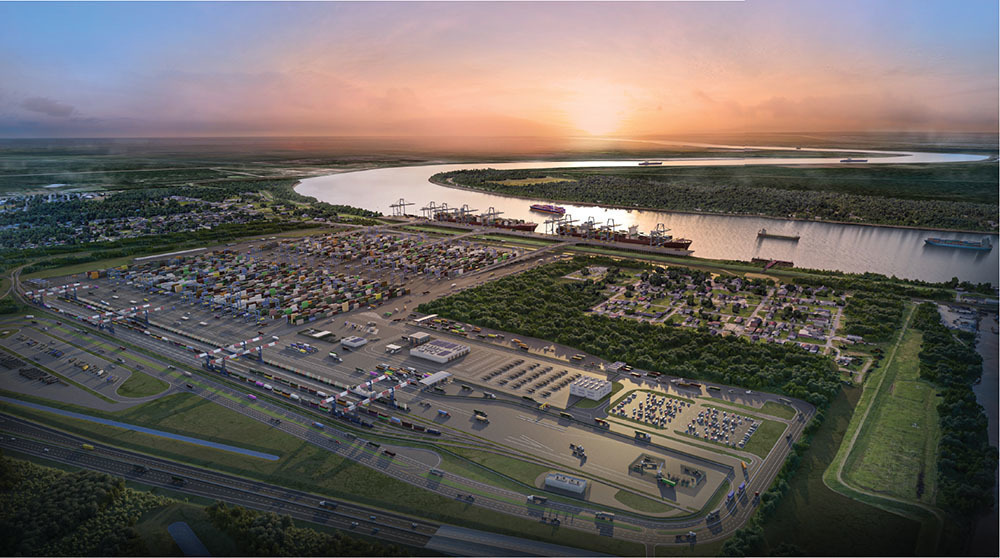
This includes assessing projects in five categories: Quality of Life, Leadership, Resource Allocation, Natural World, and Climate and Resilience. Federer explained that the Climate and Resilience section focuses on inputs to climate change when identifying the emissions of a project and the outputs for the project’s resilience in evaluating a development’s vulnerability to maximize resilience and improve the overall infrastructure. Federer said the $1.8 billion Louisiana International Terminal project is registered with Envision, making it the first project in Louisiana to seek the certification and the first new container terminal in the country to register with Envision.e and crisis management can work together.
In addition to considering climate impacts with the Envision framework, Federer said the port is exploring partnerships with the city of New Orleans and other outside organizations on potential projects that would address climate impacts, such as green infrastructure and stormwater management projects that can address excessive flooding events that are already occurring in areas of the city.
“Investing in durable, sustainable infrastructure is an overall smart business decision,” Federer said. “In referencing Envision, many infrastructure projects are built for about a 50-year horizon. However, we know the things we have built in the past have been around a lot longer than that. Investing in better designs and durable materials for future demands will likely be well worth their costs down the road.”
In some cases, port infrastructure projects are being developed with the specific aim to play defense against climate challenges. For instance, Port Tampa Bay built a 12,000-square-foot storm-hardened heavy weather building to store the port’s FEMA grant-funded response equipment and local law enforcement assets and support personnel during severe weather events, offering protection from winds and potential flooding to facilitate a quick response for the port after storms have passed.
The site has proved vital at various times in recent years, including to store port-owned heavy equipment before the arrival of Hurricane Ian in 2022 and then during three different hurricanes in 2024 — Debby, Helene and Milton. Each of those storms closed the port, Helene created major flooding and Milton brought heavy wind damage. In each case, port security and response equipment remained protected from the storms in the facility. In addition, port security and Hillsborough County sheriff’s deputies sheltered at the building during Milton and returned to the port after the storm passed, controlling access points and conducting initial damage assessments. In each case, the landside activities at the port were reopened within hours of the storms passing, in part because of the building’s presence.
Assessing and Preparing for the Risks of Sea Rise
Climate change can affect ports in very different ways depending on their locations. For the Port of Oakland, Colleen Liang, director of environmental programs and planning, said the greatest projected climate-related risk is sea level rise, which can lead to shoreline flooding and damage to port infrastructure. In addition, groundwater levels can become elevated by the encroaching subsurface sea levels, carrying an additional risk of damage.
“Sea level rise and groundwater intrusion pose an existential threat to the port and city,” said Colleen Liang, director of environmental programs and planning.
The Port of Oakland currently is focused on gaining a better understanding of their future vulnerabilities through an extensive assessment of those risks at all port areas and developing an adaptation plan. The port also is working closely with community partners to include waterfront communities in the assessment and to share information and data as part of a collaborative approach.
The plan involves conducting an asset inventory and vulnerability assessment with a focus on the port and adjacent Oakland neighborhoods. The project will model projected impacts for both the near and long term.
Similarly, Jason Giffen, chief sustainability and innovation officer for the Port of San Diego, said his port is emphasizing the risks of sea level rise in San Diego Bay.
“Over the last 10 years, we have observed the highest water levels ever recorded in the bay,” Giffen said. “As water levels increase, high tides and storm systems have caused damage to public infrastructure at specific locations around the bay. Future projections of coastal hazards by the end of the century could cause significant damage to natural resources and infrastructure located in low-lying areas around San Diego Bay.”
In response to rising water levels in San Diego Bay, the Port of San Diego prepared a vulnerability assessment and coastal resilience report for San Diego Bay in 2019. The analysis assessed the port’s vulnerability to future flooding and inundation because of sea level rise and detailed the potential costs of sea level rise impacts while featuring adaptation strategies to avoid those risks.
Today, the port is building off that report to develop a San Diego Bay Sustainable Shorelines Atlas, Giffen said. Against the backdrop that 80% of the bay’s shoreline is armored to protect against erosion and flooding, the atlas will serve as a proactive roadmap to identify areas in the bay where soft, nature-based shoreline solutions can replace traditional infrastructure. Through a partnership with the U.S. Navy and funding support from the Office of Local Defense Community Cooperation, the atlas will identify and recommend nature-based solutions to support coastal resiliency, Giffen said.
Giffen said redevelopment projects at the Port of San Diego undergo a sea level rise assessment to ensure that proposed projects are built to be resilient to future coastal hazards that could be caused by projected sea level rise.
“Notable examples are the Chula Vista Bayfront, which includes a variety of uses from recreational open space and parks to visitor-serving facilities such as hotels, convention centers and restaurants,” Giffen said. “Prior to construction of upland infrastructure, sites were raised three feet to reduce the future risk of flooding. Environmental buffers have also been implemented to restore native wetland and upland habitat which naturally dampen wave energy, prevent shoreline erosion, and retain and hold flood waters.”
Giffen said the Port of San Diego has been a pioneer of nature-based infrastructure solutions that serve to both protect shorelines and increase habitat value.
“As an example, the port removed traditional rip rap along a segment of shoreline and replaced it with bio-enhancing concrete tidepool structures,” Giffen said. “These tidepools, developed with our innovation partner ECOncrete, are designed to provide habitat for native sea life, while also maintaining the structural integrity of the shoreline. Monitoring has shown the units support more than 60 species and outperform traditional rip rap in biodiversity, biomass, and water quality.”
nvesting in Resilience and the Future
In addition to planning and preparing for climate-fueled risks, ports are diligently trying to reduce their emissions and become more sustainable operations to help limit the climate dangers of the future. Port NOLA, for instance, is a Green Marine-certified port, an organization-wide certification for sustainability measures. Those measures are assessed every year with a third-party audit. With the adoption of the Maritime Clean Air Strategy in 2021, the Port of San Diego and its partners have been investing in electric equipment, vessels, and infrastructure to reduce climate change-causing pollution. As part of reducing its role in emissions that could hasten climate change, the Port of Oakland is working toward its goal of being a zero-emissions port. That includes installing and rebuilding infrastructure, but it also entails working closely with tenants and partners on making the transition — which Liang called the most “transformative” part of the process.
One of the reasons that building climate resilience is challenging is that construction costs have grown over the past five years, putting a strain on public budgets, Giffen said. In response, he said the Port of San Diego has been offsetting costs through grants and philanthropic funding. Giffen said the Port of San Diego’s Blue Economy incubator allows innovators who are working on sustainable aquaculture and blue technology ventures to test new products that can help ensure resilience in San Diego Bay.
“Through this initiative, the port is building a portfolio of new businesses and partnerships that deliver multiple social, environmental and economic co-benefits to the port and the region,” Giffen said.
Federer believes climate resilience will grow in importance in the years ahead for the port industry, making the attention the issue is getting now in nearly every decision all the more critical, she said.
“If we want to build infrastructure and systems that support our future societies, future conditions need to be considered in all of the permanent changes we are making.”