Growing Ammonia Use, Growing Responsibility
By Lori Musser
Great teams win by anticipating the play, not reacting to it. Ammonia’s role in global industry is expanding quickly, and with that expansion comes greater risk. Seaport teams must be prepared.
Expanding Applications
Ammonia is a strategically important seaport commodity. It’s a vital component in the fertilizer that helps grow the food that feeds the world, it’s a leading refrigerant — used on a large scale in cold storage and food processing, and it’s an important chemical manufacturing feedstock.
Lately, it has also been gaining traction as a zero-carbon maritime fuel and as an efficient hydrogen carrier. With the adoption of alternative maritime fuels, greater quantities of hydrogen are expected to be moved more safely and efficiently in the form of NH3, ammonia.
Rising Volumes
According to the Department of Homeland Security’s Chemical Security Analysis Center (CSAC), annual global production of ammonia runs about 220 million tons. It’s not a niche chemical.
In 2025, about 21 million metric tons were produced in the United States, and forecasts indicate that volume could quadruple in the next five to 10 years, according to CSAC’s Jessica Cox, speaking at the May 2026 AAPA POWERS and Smart Ports workshop in Tampa.
CSAC was created to give the federal government a dedicated center for chemical threat analysis and mitigation. Based at the U.S. Army Aberdeen Proving Ground, it draws on military chemical expertise to assess critical dependencies and the risk they pose to the nation. That framing is relevant to seaports. If a major ammonia incident shuts down a terminal or undermines public confidence in ammonia as a cargo or fuel, the impact will not be confined to the waterfront. It could ripple through agriculture, manufacturing, food distribution, energy, and supply chains worldwide.
Ammonia is now found in most communities, but it is often found in its largest quantities at seaports that have major ammonia production, storage, or handling facilities. In the U.S., a dozen seaports have become important ammonia hubs, another seven are handling regular volumes, and more will soon be involved as export, import, and bunkering projects expand.
CSAC’s AmPPER and Seaport CRADA
DHS identifies the chemical sector and the transportation sector as two of its 16 critical infrastructure sectors. It says ammonia transport, storage, and use warrant serious attention, as part of its mission to safeguard national security, the economy, and public health, so it created the Ammonia Port Preparedness and Emergency Response (AmPPER) Project.
AmPPER has made progress characterizing ammonia hazards, risk, and mitigation measures through data analysis, modeling, and laboratory experimentation. It has even carried out a controlled release program in a desert environment, according to Cox.
The project has identified critical knowledge gaps, especially some related to high-concentration exposure, mitigation technologies, and real-world environments. CSAC and its research partner, Batelle, reported some promise with water curtain systems for large-scale plume mitigation. They have vetted certain air-purifying respirators, with assistance from the National Institute for Occupational Safety and Health (NIOSH) National Personal Protective Technology Laboratory, and investigated practical measures to reduce indoor exposure for those sheltering in place. A future step will be a large-scale release over water, which will help CSAC better understand dispersion in realistic port conditions.
Ammonia’s Unique Profile
Toxic inhalation hazard: It has an Immediately Dangerous to Life and Health (IDLH) value of about 300 parts per million. That’s a relatively low threshold.
High expansion and buoyancy: When released, ammonia gas expands to about 800 times its volume fairly quickly, depending on atmospheric conditions.
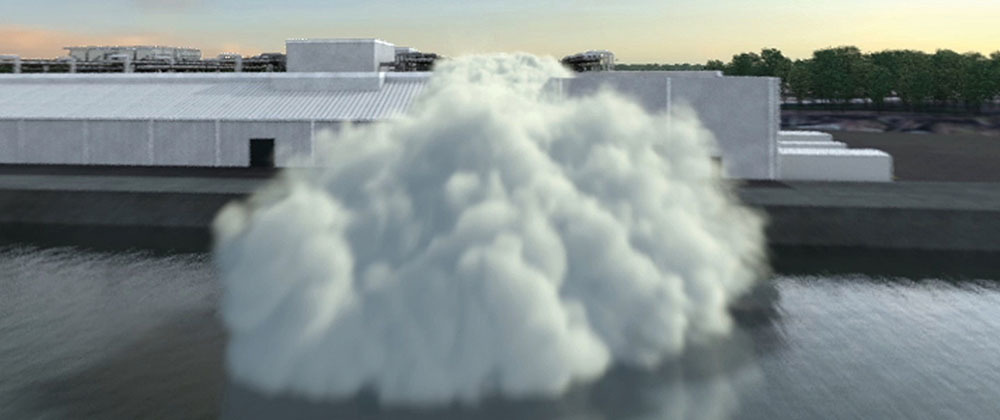
Invisibility: Ammonia in its gas state is invisible, although when it interacts with humidity or other moisture, it becomes a white cloud.
Odor as a limited safeguard: It has a low odor threshold at around 5 parts per billion, meaning it can be noticed before it is dangerous. Nevertheless, rapidly overwhelming exposure is possible.
Concentrations: Modeling conducted suggests that plume concentrations in a large release could reach far above IDLH levels.
SOURCE: DHS’s Chemical Security Analysis Center (CSAC)
Because these efforts are intended to eventually help guide seaports, among other ammonia stakeholders, CSAC and the American Association of Port Authorities (AAPA) have together established a Cooperative Research and Development Agreement (CRADA) to learn how to best transition the results to have the greatest impact. Cox said CSAC aims to provide ports with valuable input “into their standard operating procedures, safety plans, and emergency response guidelines.”
Collaboration for Preparedness
At the AmPPER workshop, Cox advised participants that, while ammonia releases have fortunately been very rare at seaports and along transportation corridors to date, moving forward, more widespread use means rising risk. Ammonia is no longer just another hazardous cargo. It is a chemical threat of national concern, and ports must plan, design, and train accordingly.
That is driving better preparedness. Ammonia inhalation can be toxic, but there are relatively affordable and portable systems to enable safe escape. Cox said ammonia facility workers should already have top-notch incident response tools at hand but immediate neighbors, such as adjoining marine terminals, may not and that is an important oversight.
There are also other expedient protective measures that can be employed by port and community members during an ammonia release, some of which are very simple including sheltering in place, shutting off vehicle or building ventilation systems, and staying low to the ground, depending on the situation.
Cox encouraged seaports to collaborate with CSAC to strengthen ammonia-related research and real-world applications. More accurate modeling and stronger preparedness measures can help ports assess their specific risks and update plans and response programs to ensure the U.S. ammonia industry and the commerce moving via U.S. ports continue to operate safely and thrive.
Because these efforts are intended to eventually help guide seaports, among other ammonia stakeholders, CSAC and the American Association of Port Authorities (AAPA) have together established a Cooperative Research and Development Agreement (CRADA) to learn how to best transition the results to have the greatest impact. Cox said CSAC aims to provide ports with valuable input “into their standard operating procedures, safety plans, and emergency response guidelines.”
Collaboration for Preparedness
At the AmPPER workshop, Cox advised participants that, while ammonia releases have fortunately been very rare at seaports and along transportation corridors to date, moving forward, more widespread use means rising risk. Ammonia is no longer just another hazardous cargo. It is a chemical threat of national concern, and ports must plan, design, and train accordingly.
That is driving better preparedness. Ammonia inhalation can be toxic, but there are relatively affordable and portable systems to enable safe escape. Cox said ammonia facility workers should already have top-notch incident response tools at hand but immediate neighbors, such as adjoining marine terminals, may not and that is an important oversight.
There are also other expedient protective measures that can be employed by port and community members during an ammonia release, some of which are very simple including sheltering in place, shutting off vehicle or building ventilation systems, and staying low to the ground, depending on the situation.
Cox encouraged seaports to collaborate with CSAC to strengthen ammonia-related research and real-world applications. More accurate modeling and stronger preparedness measures can help ports assess their specific risks and update plans and response programs to ensure the U.S. ammonia industry and the commerce moving via U.S. ports continue to operate safely and thrive.
“Ammonia is poised to play an even larger role in global trade, marine fuels, and decarbonized energy systems. For seaports, that brings both opportunity and obligation.”
All Hands On Deck
Most ports already have strong collaborations in place at home. For example, Port Tampa Bay works with their ammonia handlers and pipelines, and a broad base of agencies including: regulators (the US Coast Guard), Fire Rescue (Tampa and Hillsborough County) and Law Enforcement (Tampa Police Department and Hillsborough County Sheriff’s Office), among others, according to Mark Dubina, the port’s Vice President and Chief Security Officer.
Dubina said these long standing relationships create a foundation of trust that makes coordinated preparedness possible and effective.
Lessons from the Past

Ammonia releases are not theoretical; they occur regularly in industry, transportation, and refrigeration.
- Most are contained by trained hazmat teams, but consequences can still be severe.
- A defining example is the 1976 Houston tanker crash, when a truck carrying 7,000 gallons of anhydrous ammonia ruptured during rush hour, releasing its entire load. The ammonia plume overtook nearby vehicles and pedestrians, killing seven.
- A critical lesson emerged: those who stayed inside their vehicles survived, while those who exited succumbed quickly.
- That tragedy helped shape modern hazmat response to releases.
- Today, 50 years later, CSAC and AAPA are joining together to stay ahead of changing risks related to increasing ammonia transport and use, and to be leaders in preparedness.

Key Takeaways for Ports
While AmPPER’s technical findings continue to be compiled, several takeaways for ports, vessel operators, terminal operators, and other waterfront ammonia operations have emerged:
- Plan for neighbors, not just operators: Ammonia operations already have personal protective equipment (PPEs) and training, but ammonia doesn’t respect facility boundaries. Cox said ports should map neighboring facilities and communities with potential plume footprints, integrate non-ammonia tenants into emergency planning and drills, and coordinate PPE strategies for adjacent workers.
- Revisit shelter-in-place and community guidance: Modeling shows near-port residents may face IDLHlevel exposure. Shelter-in-place remains vital, but AmPPER is identifying simple low-cost home measures to further reduce indoor concentrations and protect residents.
- Validate and upgrade respiratory protection: Current ammonia air purifying respirators are certified to 1,250 parts per million, but modeling shows possible seaport worker exposures far higher. Ports should reassess programs, monitor AmPPER guidance, and plan escape-respirator options. It’s imperative to note, if a worker can’t get to a respiratory device, the worker isn’t protected.
- Evaluate realistic mitigation technologies: AmPPER research found limited benefit from air curtains for large-scale releases. It did find some potential for vegetation barriers, and water curtains showed promise.
- Take action now: While AmPPER’s full suite of reports and recommendations is still being rolled out, ports that welcome ammonia should consider:a.Updating risk assessments to reflect future ammonia uses and volumesb.Engaging with CSAC and AAPA to access findings and technical guidancec. Integrate ammonia-specific scenarios into emergency response preparations and plansd.Expand training and awareness beyond ammonia operatorse.Review community outreach and alerting protocols to ensure clear and fast communication during a release
Silence Is a No Go
Silence is dangerous. So is a lack of preparedness. In the not-too-distant past, industry was often reluctant to share information about hazardous materials. They undoubtedly had fears rooted in real concerns, but those types of fears can prevent good businesses from being as safe, resilient, and trusted as they could be.
Controlled transparency is vital. Relevant information must be shared for safety and to build trust. Not sharing information can increase confusion and risk, but the key is to not overshare, which may create noise instead of clarity.

Dubina noted that seaports have an important role to play supporting industry led public education. In Tampa, first responders stay prepared through recurring multi agency meetings, shared best practices, and port funded equipment and exercises. For example, the port maintains federally funded warning sirens to alert nearby residents and workers of a potential release. Communities receive clear instructions through city and county alert systems, with messages delivered by text, email, and voice, reinforced by local media. There are concise, continuous updates, including how to shelter in place.
Dubina said, “Proper planning, understanding the operations occurring in the areas likely to be impacted, understanding the potential duration of an event, having alternate routes in place around impacted areas,” combined with strong community safety measures, are essential to maintaining safety and minimizing disruption.
Making More Resilient Ports and Communities
Ammonia is poised to play an even larger role in global trade, marine fuels, and decarbonized energy systems. For seaports, that brings both opportunity and obligation. The AmPPER project is an early, but important, step to assist with ammonia safety at U.S. seaports, one that is grounded in science, increasingly informed by real-world port operations, and focused on protecting workers, communities, and commerce.
It is clear that ammonia must be respected. With the emerging body of DHS research and AAPA’s voice, seaports can work to get ahead of future risks and help retain the global and regional benefits brought by the ammonia industry. Early adopters of revitalized ammonia preparedness planning will be the recognized leaders in next-generation port safety and resilience.
Note: General information for this May 14, 2026 AAPA AmPPER workshop summary was collected from a feature presentation by Jessica Cox, Lead Chemist/Program Manager, DHS CSAC and DEVCOM CBC, as well as from break-out session presentations by: Joseph “Jim” Zarzycki, Consultant, J.H. Zarzycki, LLC; Matt Rowley, R & D Chemical Engineer, Batelle; and Brian Owen, Project Manager/Researcher, Joint Research and Development, DHS.