Designing Ports for Today and Tomorrow
Panel Discussion Shows How Ports Are Prioritizing Flexibility in Building for the Future
By Nick Fortuna
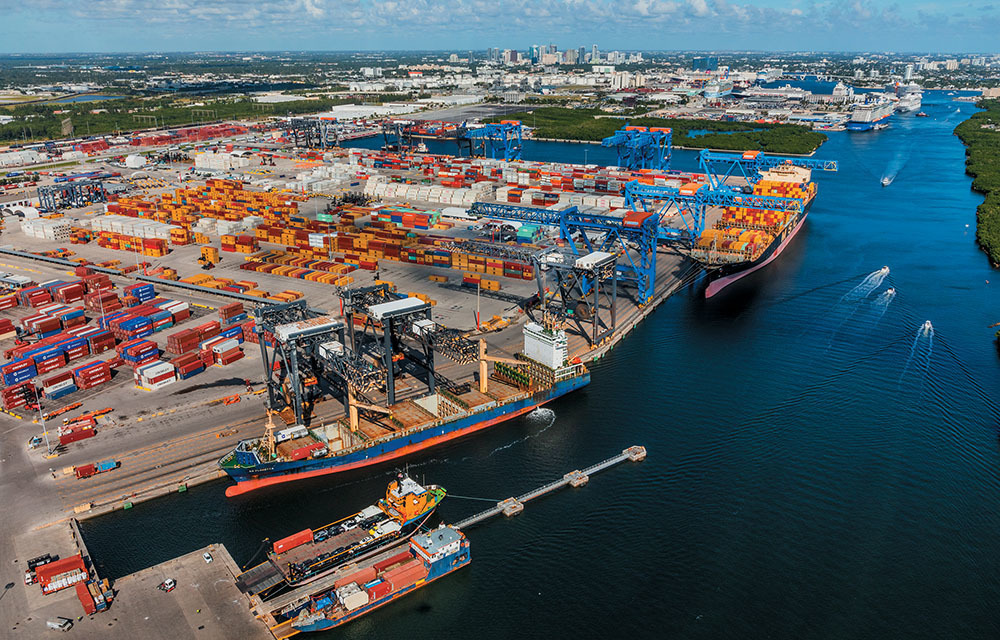
Ports are making long-term infrastructure decisions in an environment where their operational needs and business dynamics continue to evolve. That’s why port infrastructure projects should be designed with flexibility and future expansion in mind, positioning ports to take advantage of emerging opportunities and to maximize revenue.
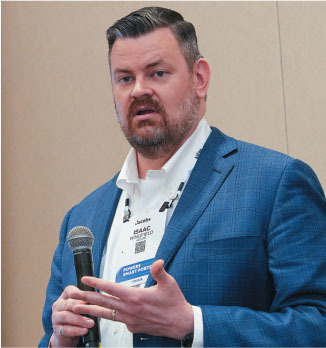
That’s a message from Kile Alford, assistant director of the seaport engineering and construction division at Port Everglades, and Isaac Wingfield, global ports lead for AECOM, a leading global infrastructure consulting and engineering firm. On May 13, at the AAPA’s POWERS + Smart Ports Summit & Expo in Tampa, Alford and Wingfield led a panel discussion showcasing infrastructure projects designed for adaptability.
Alford pointed to several recent projects at Port Everglades, including the Heron parking garage, a five-floor building with 1,818 parking spaces for cruise passengers. The garage, opened to the public in 2021, was designed so that two additional floors can be added at a later date, providing approximately 800 additional parking spaces.
Alford said that project is a good example of how ports can build to meet their current needs, give themselves room to grow and defer those additional costs until extra capacity is needed.
“Ports can do scaled-infrastructure investments that align with their monetary constraints and will allow them to respond to future conditions,” he said. “These investments in our infrastructure provide us with the flexibility to do incremental investments down the road and realize the full potential of our assets.”
Through careful planning and engineering, Port Everglades was able to open the bottom levels of the parking garage while construction on the top three levels continued. That meant that the ground floor could be used for boarding cruise passengers and ground-transportation operations far ahead of the garage’s scheduled completion date. The new garage and the ability to expand it were key factors in attracting a new cruiseline tenant shortly after the facility opened, Alford said.
Should the port move forward with a vertical expansion of the garage, two floors likely would be closed to the public temporarily for construction operations, but the facility could continue to operate and generate revenue.
Building the garage in phases required extensive foundation, shoring, and concrete work. Additionally, engineering analysis was performed to ensure that the overall structure would remain stable without the benefit of large, continuous columns from the base to the roof. The solution was to build the garage with larger lateral frames and columns than traditionally seen in precast parking structures.
“There’s no doubt that putting in these more-robust structures comes with higher upfront costs, but that initial investment ends up being cheaper in the long run than going in and doing retrofits at a later date,” Alford said. “We’ve gotten our port leadership to buy into the philosophy that it’s cheaper and less disruptive to operations to make that bigger initial investment.”
Building Adjustable Bulkheads
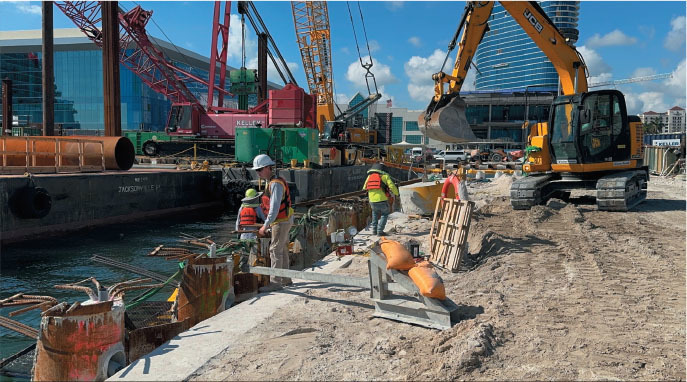
Port Everglades is taking a similar approach with its $152 million bulkhead replacement project. The port is replacing approximately 2,800 linear feet of its waterfront bulkheads, some dating to the 1950s, with a modern steel sheet-pile combi-wall system. The project involves constructing a new wall just seaward, or in front, of the existing bulkhead, then filling in the space between the old and new structures.
For this port-wide project, Port Everglades has chosen sheet piles, H-piles and pipe piles that are overdesigned for the current loads, meaning they are capable of supporting additional weight in the future. That stronger design will allow the port to respond to sea-level rise by installing larger concrete caps and curbs.
“Rather than making an infrastructure investment based on a future sea-level-rise projection, the port will have the ability to incrementally raise our bulkheads as a response to real-world observations,” Alford said. “We decided to invest in increasing that structural strength so that we have flexibility in the future.”
Wingfield said several of AECOM’s port clients are seeking greater flexibility to handle diverse types of cargo and accommodate different types of vessels. That adaptability is especially important given that geopolitical developments and global trade dynamics have been changing rapidly and unpredictably, leaving port administrators uncertain about their future needs.
“Ports are always trying to identify flexible uses for their facilities because the market may change, and most port authorities try not to have all of their eggs in one basket,” Wingfield said. “If the market shifts, they want to be able to shift with it, and that can be a real challenge because no one has a crystal ball.”
Wingfield pointed to two U.S. port clients that are seeking to develop large parcels of land for densified container handling. Currently, the ports don’t have enough container demand to justify the cost of a full buildout, including purchasing cranes and other equipment and installing all the mechanical and electrical components.
Rather than committing to that large capital expenditure and then enduring a period of low utilization, the ports decided upon a phased approach. They would develop a portion of their parcels for container handling, which is among the most-profitable cargo operations for ports, and seek interim cargos requiring minimal infrastructure to use the rest of the parcels. For those areas, lower-revenue options include roll-on/roll-off operations.
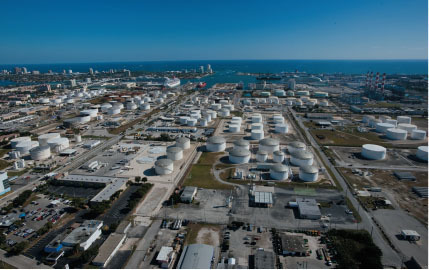
“When the market signals more capacity, then those ports can justify the final finish of those areas for what would be their highest and best use: densified container handling,” Wingfield said. “But you don’t want to buy all your container cranes for a full buildout on day one when you don’t need them. They’re costly, and they begin to depreciate right off the bat, so you want to defer those purchases and find other uses for the remaining space.”
Tracking Turn Times
With an eye on expansion, some ports are setting aside space to add lanes to their inbound and outbound gates, enabling them to respond if turn times begin to creep up to unacceptable levels, Wingfield said.
“Adding lanes is relatively easy to do as long as you’ve kept the space, but that requires detailed planning for the future,” he said. “That’s why the best practices are to not rush the planning and to involve your entire organization. As an industry, we spend a lot of money on pavement, but when we look out across our terminals, the pavement is riddled with post-installed utilities.
“So, anything we can do to anticipate where those utilities would need to be installed, or at least to ensure that they’re installed out of the way, as opposed to in primary drive aisles, always helps with the with longevity of our investments.”
Wingfield said port clients are planning for increased energy needs, another key factor in port infrastructure design. Whether they’re installing peak shaving onsite, allocating space for electric charging stations, increasing their capacity to handle refrigerated or frozen products or reserving berth area for future vessel shore power, ports face growing energy challenges in addition to budgetary constraints.
In May, Wingfield pointed to the U.S. war on Iran and the closure of the Strait of Hormuz, noting that the resulting energy crisis is forcing ports to be adaptable and plan for their future energy needs.
“The events happening right now are accelerating that because by and large, the industry is still very dependent on diesel, and when you’re hit with large price swings like this, you want to find a better way to insulate your energy prices as an operator,” Wingfield said.
“Port operations can be very powerhungry,” he added. “If you’re supporting the cruise industry, you’re essentially plugging a small city into the electrical grid, and if you’re a diverse cargo handler, your energy demands could be dispersed across a wide area. So, as you plan infrastructure projects, your organization needs to account for that. Installing at least the empty/spare infrastructure — the conduits and the elements that would support pulling cable in the future — is as cheap today as it’s ever going to be. It’s never going to get cheaper or less disruptive to rip open your terminal and install more duct bank”