Shore Power Is a System: Lessons Learned from Implementation
By Sean McCaskill, Igus
Across North America, ports are moving from planning to execution on shore power at an unprecedented pace. Driven by emissions mandates, community expectations, and fleet electrification strategies, shore power has shifted from a long-term sustainability goal to near-term operational infrastructure.
As this transition accelerates, one lesson has become clear: shore power projects succeed or struggle not because of technology alone, but because of how they are planned, structured, and delivered.
That lesson was reinforced for us this year when our mobile shore power outlet system was recognized with the “Lighthouse” Maritime Innovator of the Year award. While the award acknowledged a specific solution, the broader takeaway is one many ports are now encountering firsthand. Innovation in shore power is not only about equipment — it is about understanding shore power as a system and assembling the right people at the right time to deliver it.
Shore Power Is Not a Product — It Is Infrastructure
One of the most common early missteps in shore power implementation is treating it as a discrete piece of equipment rather than as long-life infrastructure. In practice, shore power sits at the intersection of utility interconnection, vessel requirements, berth geometry, operational workflows, safety systems, and maintenance planning.
Decisions made early — such as voltage selection, connection location, cable routing, equipment operation, and expansion assumptions — tend to persist for decades. These choices affect not only current vessel calls, but future fleets, berth reassignment, and terminal growth that may not yet be fully defined.
Ports that approach shore power as infrastructure rather than as a procurement exercise are better positioned to manage risk. Optimizing one component in isolation can unintentionally constrain operations elsewhere. A systems mindset helps avoid designs that look sound on paper but prove inflexible or costly to adapt once vessels are connected, and crews begin operating them day to day.
The Right People at the Right Time
Equally important as technical planning is assembling the right project team — and doing so in the correct sequence. Successful shore power projects consistently demonstrate early collaboration among port stakeholders, manufacturers, and independent consultants, with each group contributing distinct expertise.
Manufacturers play a critical role early in the process. Their value extends well beyond supplying equipment; it lies in deep familiarity with how systems behave once installed and operated. Manufacturers understand tolerances, interfaces, installation constraints, and maintenance realities at a level that is difficult to replicate elsewhere. Engaging them early allows ports to ground conceptual designs in practical feasibility before assumptions become embedded in specifications, civil layouts, or utility applications.
Independent consultants remain essential, particularly in verifying designs, ensuring compliance, and translating standards into locally approvable solutions. They help interpret utility requirements, authority-having-jurisdiction expectations, and regional safety codes. The most effective projects recognize a clear division of strengths: manufacturers lead on product-centric design and operational behavior, while consultants validate, localize, and independently assess those designs. When these roles are aligned rather than duplicated, projects move more efficiently and with greater confidence.
Ports themselves remain the anchor. Only port operators fully understand berth utilization patterns, vessel scheduling realities, and long-term operational priorities. When those insights are integrated early, projects encounter fewer surprises during commissioning and operation.
Designing Once, Localizing Everywhere
Global standards have accelerated shore power adoption, but standardization alone does not guarantee success. Even fully compliant designs must be adapted to local conditions — utility interconnection rules, fire and life safety codes, seismic requirements, labor practices, and permitting processes.
Projects that anticipate localization as a core design step, rather than an afterthought, move more smoothly through approvals and construction. This is where collaboration between manufacturers and consultants becomes especially valuable. Manufacturers bring proven system architectures, while consultants ensure those architectures align with local regulatory frameworks without undermining performance or safety.
This approach also builds confidence among utilities and regulators. Designs that clearly reflect both global best practices and local compliance realities are easier to review, approve, and support.
Flexibility as Risk Management
Another consistent lesson from implementation is the value of flexibility. Vessel fleets evolve faster than infrastructure. Berth assignments change. Regulatory frameworks tighten. Ports that build adaptability into their shore power systems are better equipped to respond without costly retrofits.
Flexibility does not mean overbuilding. It means thoughtful planning — anticipating multiple vessel types, future capacity needs, and evolving operational patterns. In practice, flexible designs reduce the risk of stranded assets and improve long-term return on investment.
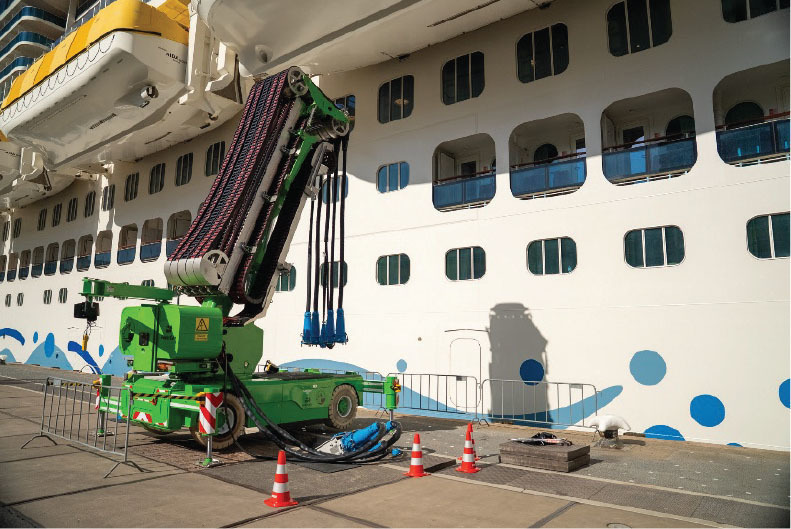
This realization directly informed the development of mobile shore power outlet concepts such as iMSPO. By decoupling the power interface from fixed berth geometry, mobile outlet architectures allow ports to accommodate vessel variability, berth reassignment, and phased expansion with significantly less disruption. That flexibility reduces multiple categories of risk simultaneously: technical risk as vessel requirements change, financial risk tied to fixed infrastructure, and regulatory risk as standards and operating practices evolve.
Rather than solving for a single snapshot in time, flexible connection strategies acknowledge a fundamental reality of ports — they are dynamic environments.
Planning Is the Real Innovation
As shore power moves from pilot projects to core port infrastructure, the industry’s focus must extend beyond individual technologies. The most successful implementations are those where planning, collaboration, and verification are treated as integral components of innovation.
Awards and recognition often highlight hardware, but behind every successful shore power project is a disciplined process: a systems mindset, early engagement with experienced partners, and a willingness to plan not just for compliance, but for longterm operation.
For ports beginning their shore power journey — or scaling existing installations — the lesson is clear. Innovation is not only what is installed at the berth. It is how decisions are made, how teams are assembled, and how thoughtfully the system is designed to serve the port for decades to come.
About the author: Sean McCaskill serves as Shore Power Manager, Americas, focusing on the planning and implementation of shore power infrastructure for ports worldwide. His work centers on system-level design, collaboration with project stakeholders, and translating global standards into practical, flexible port solutions.